Kabhi Ai Haqeeqat-e-Muntazar: Iqbal’s Audacious Call to God
When faith turns into hollow routine, the soul demands an encounter so tangible it burns. Allama Iqbal challenges the Divine to step out of abstraction and meet him in the physical world.
There are nights when prayer feels like speaking into an empty telephone wire. You kneel, you bend your back, you whisper familiar phrases, but nothing pushes back against your chest. The silence on the other end feels less like holy mystery and more like sheer absence.
Nearly a century ago, Muhammad Iqbal sat with that exact restlessness. He did not retreat into quiet resignation, nor did he abandon his faith. Instead, he did something breathtakingly daring: he demanded that the Ultimate Reality stop hiding behind cosmic abstractions. In his celebrated ghazal, opening with the immortal line *Kabhi ai haqeeqat-e-muntazar nazar aa libaas-e-majaz mein*, Iqbal calls out to the divine presence as an equal partner in longing, insisting that if reverence is to mean anything at all, it must happen here in the messy, aching, physical world.
A Cry for the Unseen: Form, Meter, and Iqbal's Restless Soul
Composed in Iqbal's middle period and included in his seminal 1924 Urdu collection *Bang-e-Dra* (The Call of the Marching Bell), this poem is structured as a classical ghazal. In the Urdu poetic tradition, the ghazal is composed of autonomous couplets, known as shers. Each sher forms an independent universe of thought and mood, bound together by a shared musical architecture.
Here, the unifying rhythm is established by the *radif*—the invariant repeating phrase at the end of each second line: *mein* (in). Directly preceding this is the *qafia*, the rhyming syllable that drives each couplet's momentum: *majaaz*, *niyaaz*, *saaz*, *aaina-saaz*, *gudaaz*, *banda-nawaaz*, *ayaaz*, and *namaaz*. The opening couplet, or *matla*, introduces both rhyming constraints simultaneously, pulling the listener into an urgent cadence. While traditional ghazals often celebrate romantic surrender, Iqbal infuses this strict classical container with existential fire, turning an ancient love song into a battleground between human longing and cosmic silence.
Wrestling with the Divine: The Ghazal Unfolded
Across seven couplets, Iqbal moves from an intimate challenge to God, through meditations on brokenness and artistic creation, arriving finally at a devastating confession about human insincerity.
The Demand for Presence
کبھی اے حقیقت منتظر نظر آ لباس مجاز میں
کہ ہزاروں سجدے تڑپ رہے ہیں مری جبین نیاز میں
कभी ऐ हक़ीक़त-ए-मुंतज़र नज़र आ लिबास-ए-मजाज़ में
कि हज़ारों सज्दे तड़प रहे हैं मिरी जबीन-ए-नियाज़ में
Kabhī ai haqīqat-e-muntazr nazar ā libās-e-majāz mein,
Ki hazāron sajde taṛap rahe hain mirī zabeen-e-niyāz mein
O awaited Truth, appear just once in the garment of metaphor, for thousands of prostrations are writhing in agony upon my humble forehead.
The ghazal opens with an audacious address: *haqeeqat-e-muntazar*, the 'awaited truth' or reality that humanity has sought through millenia of philosophy and theology. Iqbal commands this absolute truth to reveal itself in *libaas-e-majaz*—the robe of metaphor, the material form, the world of senses.
Notice the physical violence in the word *tarap* (writhing, twisting in anguish). The poet does not say he wishes to pray; he says thousands of unoffered prostrations are trapped inside his forehead, struggling like caged birds to break free. In Islamic practice, the *sajda* (prostration) places the brow against the dust in absolute submission. But submission requires an object. How can a lover bow to an abstraction? By personifying the forehead as an overcrowded vessel of devotion, Iqbal turns spiritual worship into a tangible, visceral hunger.
The Unplayed Melody
طرب آشنائے خروش ہو تو نوا ہے محرم گوش ہو
وہ سرود کیا کہ چھپا ہوا ہو سکوت پردۂ ساز میں
तरब-आशना-ए-ख़रोश हो तू नवा है महरम-ए-गोश हो
वो सरोद क्या कि छुपा हुआ हो सुकूत-ए-पर्दा-ए-साज़ में
Tarab-aashna-e-kharosh ho tu nawa hai mahram-e-gosh ho / Woh sarod kya ki chupa hua ho sukoon-e-parda-e-saaz mein
Become acquainted with the pleasure of roaring passion; you are a melody, so become intimate with the ear. What kind of song remains hidden in the silence behind the musical instrument's curtain?
Having demanded a physical presence, Iqbal shifts the metaphor to music. He addresses the Divine as an unexpressed song (*nawa*) that remains trapped behind the veil of the lute (*sukoot-e-parda-e-saaz*). A song achieves its true nature only when it is played and heard; otherwise, it is merely potential.
The emotional pivot turns on the word *mehram*, a confidant or someone bound by intimate kinship. Iqbal argues that beauty has an obligation to be experienced. Silent perfection is sterile. By remaining detached and unheard, the song refuses its own destiny. The poet suggests a startling paradox: the creator needs the ear of the created just as desperately as the listener needs the music.
The Glory of the Shattered Glass
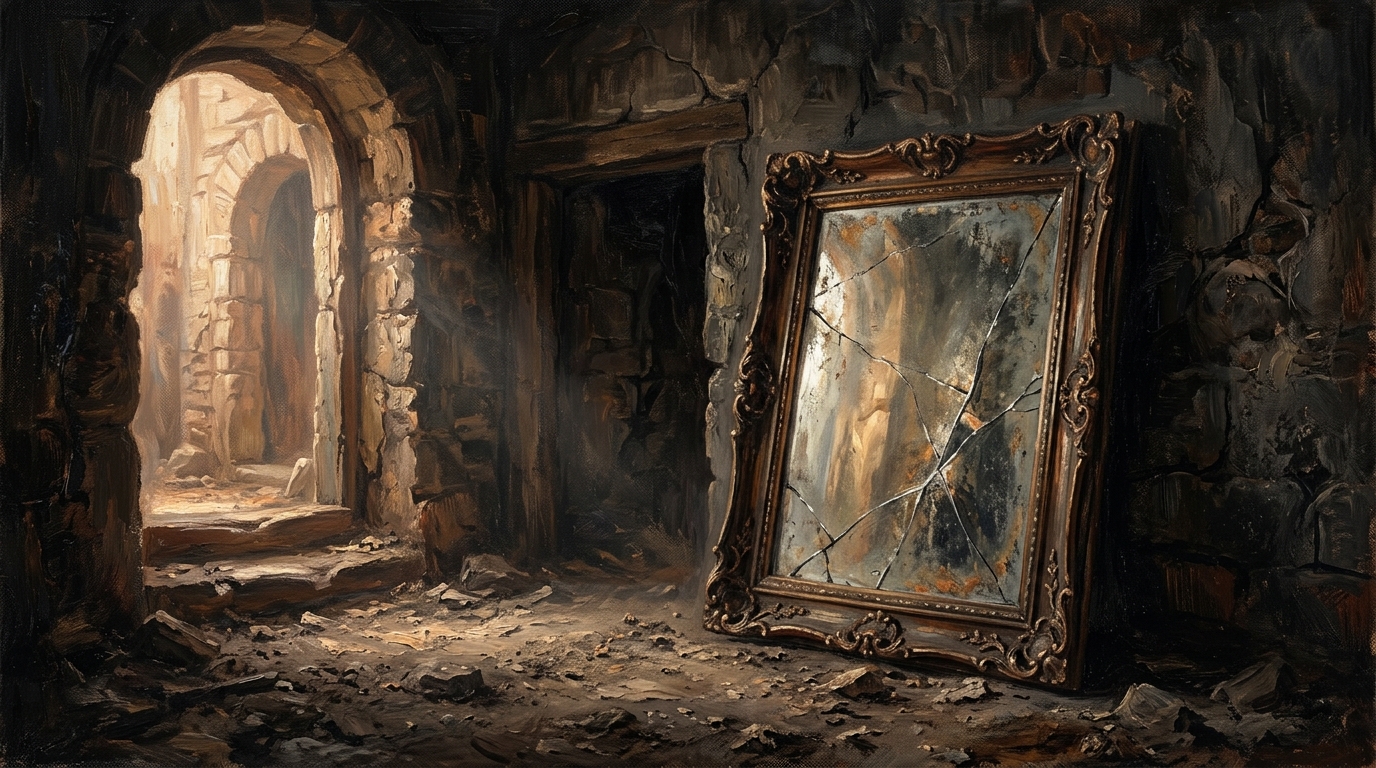
تو بچا بچا کے نہ رکھ اسے ترا آئنہ ہے وہ آئنہ
کہ شکستہ ہو تو عزیز تر ہے نگاہ آئنہ ساز میں
तू बचा बचा के न रख इसे तिरा आइना है वो आइना
कि शिकस्ता हो तो अज़ीज़-तर है निगाह-ए-आइना-साज़ में
Tu bachā bachā ke na rakh ise, tirā āīnā hai vo āīnā; ki shikastā ho to azīz-tar hai nigāh-e-āīnā-sāz mein
Do not hoard and shield it; your mirror is that very mirror which, once broken, becomes far more precious in the eyes of the mirror-maker.
In Persian and Urdu metaphysics, the human heart is conventionally depicted as a mirror reflecting divine light. Most poets counsel guarding this mirror against dust and cracks. Iqbal inverts the trope entirely. He urges us to stop shielding our hearts from pain, experience, and fallibility.
The turn here is breathtaking: a shattered mirror multiplies the facets reflecting the light. In the eyes of the *aaina-saaz* (the Divine artisan), a heart that has remained safely unbroken is untested and dull. But a heart that has dared to live, failed, suffered, and fractured carries wounds that reveal its inner depth. God does not cherish our sterile perfection; He cherishes the cracks through which our humanity bleeds.
The Cold Ashes of Modern Love
دم طوف کرمک شمع نے یہ کہا کہ وہ اثر کہن
نہ تری حکایت سوز میں نہ مری حدیث گداز میں
दम-ए-तौफ़ किरमक-ए-शम्अ ने ये कहा कि वो असर-ए-कुहन
न तिरी हिकायत-ए-सोज़ में न मिरी हदीस-ए-गुदाज़ में
Dum-e-tauf kirmak-e-shama ne ye kaha ki vo asar-e-kuhan
Na teri hikayat-e-soz mein na meri hidayat-e-gudaaz mein
While circumambulating the candle, the tiny moth remarked: that ancient passion is gone, neither in your tale of burning nor in my narrative of melting.
Here, Iqbal borrows the archetypal Eastern parable of the candle and the moth (*shama aur parwana*). Traditionally, the moth hurls itself into the flame in selfless annihilation (*fana*). But during this nocturnal dance, the moth stops and makes a grim observation.
The ancient heat (*asar-e-kuhan*) has evaporated. The flame flickers without genuine fire, and the moth circles without true abandon. This is Iqbal’s critique of his modern age: an era where rituals remain intact, but the soul has been hollowed out. Intellectual cleverness has replaced existential passion; both lover and beloved are merely reciting rehearsed lines.
The Haven of Infinite Grace
نہ کہیں جہاں میں اماں ملی جو اماں ملی تو کہاں ملی
مرے جرم خانہ خراب کو ترے عفو بندہ نواز میں
न कहीं जहाँ में अमाँ मिली जो अमाँ मिली तो कहाँ मिली
मिरे जुर्म-ए-ख़ाना-ख़राब को तिरे अफ़्व-ए-बंदा-नवाज़ में
Na kahin jahaan mein amaan mili jo amaan mili toh kahaan mili, mere zarm-e-khaana-khaarab ko tere afwa-e-banda-nawaaz mein
Nowhere in this world did I find sanctuary, and if I did find refuge, where was it? Only in your generous pardon for my household-ruining sins.
From cosmic lament, Iqbal drops suddenly to personal humility. The phrase *jurm-e-khaana-kharaab* conveys sins so profound, so reckless, that they demolish one's own dwelling. The world offers no shelter to someone who has ruined himself through his own folly.
The only refuge found is *afv-e-banda-nawaaz*—the cherishing, patronizing forgiveness of the Divine. Notice how this couplet grounds the earlier audacity. The poet who dared to command God to appear now acknowledges that his only standing before that same God is that of a bankrupt wanderer resting inside unearned grace.
When Grand Passions Tame
نہ وہ عشق میں رہیں گرمیاں نہ وہ حسن میں رہیں شوخیاں
نہ وہ غزنوی میں تڑپ رہی نہ وہ خم ہے زلف ایاز میں
न वो इश्क़ में रहीं गर्मियाँ न वो हुस्न में रहीं शोख़ियाँ
न वो ग़ज़नवी में तड़प रही न वो ख़म है ज़ुल्फ़-ए-अयाज़ मैं
Na woh ishq mein rahīn garmiyān na woh husn mein rahīn shokhiyān,
Na woh Ghaznavi mein taṛap rahī na woh khum hai zulf-e-Ayaz main
Neither does passion retain its former warmth, nor does beauty hold its playful coquetry; neither is Mahmud restless with longing, nor do Ayaz’s curls carry their hypnotic snare.
Iqbal invokes the legendary historical romance of Sultan Mahmud of Ghazni and his favored courtier Ayaz, an established emblem in Sufi literature representing the powerful ruler who becomes a willing slave to love. In Iqbal’s hands, their story becomes a measuring stick for civilizational vitality.
The world, Iqbal laments, has grown lukewarm. The great kings of the spirit no longer lose their minds to longing, and beauty no longer possesses the wild unpredictability that can overthrow an empire. Everything has become safe, domesticated, and dull.
The Rebuke from the Dust
جو میں سر بہ سجدہ ہوا کبھی تو زمیں سے آنے لگی صدا
ترا دل تو ہے صنم آشنا تجھے کیا ملے گا نماز میں
जो मैं सर-ब-सज्दा हुआ कभी तो ज़मीं से आने लगी सदा
तिरा दिल तो है सनम-आश्ना तुझे क्या मिलेगा नमाज़ में
Jo main sar-ba-sajda hua kabhi to zameen se aane lagi sada
Tira dil to hai sanam-aashna tujhe kya milega namaz mein
When I bowed my head in prostration, a voice arose from the earth: Your heart is devoted to idols; what will you ever gain from prayer?
The ghazal concludes not on a lofty theological resolution, but with a shock of self-indictment. The poet finally bends to execute that very *sajda* he boasted of in the opening couplet. But as his forehead hits the ground, it is not God who speaks from the heavens; the dry earth beneath him speaks back.
The earth calls him out as *sanam-aashna*—a worshipper of idols. These idols are not stone statues, but the ego, worldly status, petty fears, and mental dogmas. Iqbal closes the poem by dismantling his own pretense. You demanded that God reveal Himself, yet your own heart remains cluttered with false gods. The journey ends not in divine spectacle, but in terrifying self-examination.
Words to Know
حقیقتِ منتظر (Haqeeqat-e-muntazar)
The awaited reality; the ultimate divine truth sought by seekers.
لباسِ مجاز (Libaas-e-majaz)
The garment of physical metaphor or worldly existence; visible form.
جبینِ نیاز (Jabeen-e-niyaaz)
The forehead of supplication; the humble brow ready to bow.
محرمِ گوش (Mehram-e-gosh)
Intimate with the ear; a sound that enters the innermost chamber of listening.
شکستہ (Shikasta)
Broken, shattered; in Sufism, a heart crushed by remorse or suffering.
دمِ طوف (Dam-e-tauf)
At the moment of circumambulation; circling a sacred center like a moth.
عفوِ بندہ نواز (Afv-e-banda-nawaaz)
The pardon of the master who cherishes and sustains his humble servant.
صنم آشنا (Sanam-aashna)
Familiar with idols; harboring hidden allegiances to ego or worldly desires.
The Life Behind the Lines: Iqbal’s Restless Dawn
Sir Muhammad Iqbal (1877–1938) occupied a unique crossroads in intellectual history. Educated in Lahore, Cambridge, and Heidelberg, he mastered Western philosophy alongside classical Islamic thought. When this poem was published in *Bang-e-Dra* in 1924, the Indian subcontinent was grappling with colonial rule, cultural dislocation, and religious inertia.
Iqbal was deeply troubled by the passivity of traditional Eastern religiosity, which he felt had decayed into fatalism. Influenced by both Rumi's ecstatic love and modern philosophical concepts of will, Iqbal conceived of *Khudi*—the cultivation of an active, resilient human self. This ghazal embodies that philosophy: faith is not motionless quietism, but an active, daring pursuit that demands sincerity and courage from both the mortal seeker and the Divine.
Echoes Across Time: Brokenness as Divine Portal
Iqbal’s vision of the shattered mirror (*aaina-e-shikasta*) finding special favor with God shares deep roots with mystical traditions across continents. In the Hebrew tradition, Psalm 51 affirms that 'a broken and contrite heart, O God, You will not despise.' Centuries later, the Hassidic master Kotzk Rebbe observed that 'there is nothing so whole as a broken heart.'
A striking European resonance lives in the poetry of Rainer Maria Rilke. In his *Book of Hours*, Rilke addresses God not as a distant monarch, but as a reciprocal partner who is dark, elusive, and incomplete without human hands to build His temples. Like Iqbal, Rilke believed that God waits to be incarnated in the concrete fabric of human struggle, and that a polite, cushioned faith is merely an excuse to avoid being transformed by the fire.
Why It Still Matters: Living Beyond the Routine
Our world today has perfected the art of the hollow performance. We click, attend, schedule, and recite, yet we often feel completely detached from whatever we are doing. We live sheltered lives, protecting our egos from fractures, terrified of vulnerability.
Iqbal’s verse reminds us that true encounter—whether with God, art, or another human being—demands total skin in the game. It demands that we bring our shattered pieces into the light instead of pretending to be pristine. And it issues an unsettling warning: before we complain about the absence of the divine or the sacred in our lives, we must look at what our hearts are truly kneeling before.
When you bow down today, are you reaching for what is genuine, or are you merely comforting the idols you have built inside?
The mirror only shines its brightest when it has known the hammer.
Explore in Sukhan AI
This article is linked to poems, poets, and couplets from the Sukhan AI archive.
What is the core meaning of Kabhi Ai Haqeeqat-e-Muntazar?
It is an intimate appeal from the seeker to the Divine, asking God to reveal Himself in physical, tangible form. The poet argues that abstract belief cannot satisfy the human soul's desperate need for genuine connection.
Who are Mahmud and Ayaz mentioned in the ghazal?
Sultan Mahmud of Ghazni and his beloved courtier Ayaz are classical symbols in Urdu and Persian poetry of selfless devotion, where the ruler willingly becomes a servant to love. Iqbal laments that modern life lacks this intense, transformative passion.
What does Iqbal mean by the broken mirror being dear to God?
The mirror represents the human heart. Rather than preserving a fragile, untested innocence, Iqbal suggests that a heart broken through genuine suffering, repentance, and life's trials reflects divine mercy and beauty far more brilliantly than an unblemished one.
What is the significance of the final couplet where the earth speaks?
The earth’s voice delivers a shocking reality check. While the poet prides himself on deep devotion, the dust under his forehead accuses him of worshipping inward idols—vanity, ego, and worldly desires—making his ritual prayers meaningless until his heart is cleansed.