There is a peculiar humiliation in unrequited love that anyone who has ever loved in silence recognizes instantly. You walk into a room convinced you have kept your dignity intact, only to realize your secret was never yours to keep. The friends gathered in the corner know it. The mutual acquaintances whispering by the door know it. The entire universe seems complicit in watching your unraveling.
Yet the one person for whom your chest aches continues to look right through you, wearing an expression of immaculate, untroubled innocence. It is this exact emotional crossroad—the agony of being exposed to everyone except the one who holds your fate—that Mir Taqi Mir captured more than two centuries ago in the immortal refrain, 'Patta patta boota boota haal hamara jaane hai'.
The Anatomy of a Garden: The Poem at a Glance
Penned by Mir Taqi Mir (1723–1810), the supreme master whom later poets reverently called Khuda-e Sukhan—the God of Poetry—this ghazal embodies the refined, conversational melancholy of the Delhi school.
In classical Urdu poetry, a ghazal does not tell a continuous story; rather, each couplet (sher) forms an autonomous universe. What binds them together is the music of their meter, the radif (the identical refrain anchoring the end of every second line), and the qafia (the rhyming syllable immediately preceding it).
Here, the radif is 'jaane hai' ('knows'), a simple, rhythmic ticking that pulses like a heartbeat across all ten couplets. The qafia moves through 'saara', 'taara', 'aara', 'waara', 'chaara', and beyond. The opening couplet, or matla, introduces this dual rhyme scheme with explosive clarity, while the closing couplet, the maqta, carries Mir's signature pen-name, turning inward to interrogate his own tragic thirst.
Walking Through the Garden: The Verses, Explained
To read Mir is to walk through an orchard where beauty and devastation share the exact same soil. Let us examine each couplet in turn, uncovering the psychological drama hidden beneath its melodic surface.
The Deafening Secret of the Rose
پتا پتا بوٹا بوٹا حال ہمارا جانے ہے
جانے نہ جانے گل ہی نہ جانے باغ تو سارا جانے ہے
पत्ता पत्ता बूटा बूटा हाल हमारा जाने है
जाने न जाने गुल ही न जाने बाग़ तो सारा जाने है
Patta patta boota boota haal hamara jaane hai
Jaane na jaane gul hi na jaane baagh toh saara jaane hai
Every leaf and every bush knows our condition;
Whether the rose knows or not, the entire garden knows.
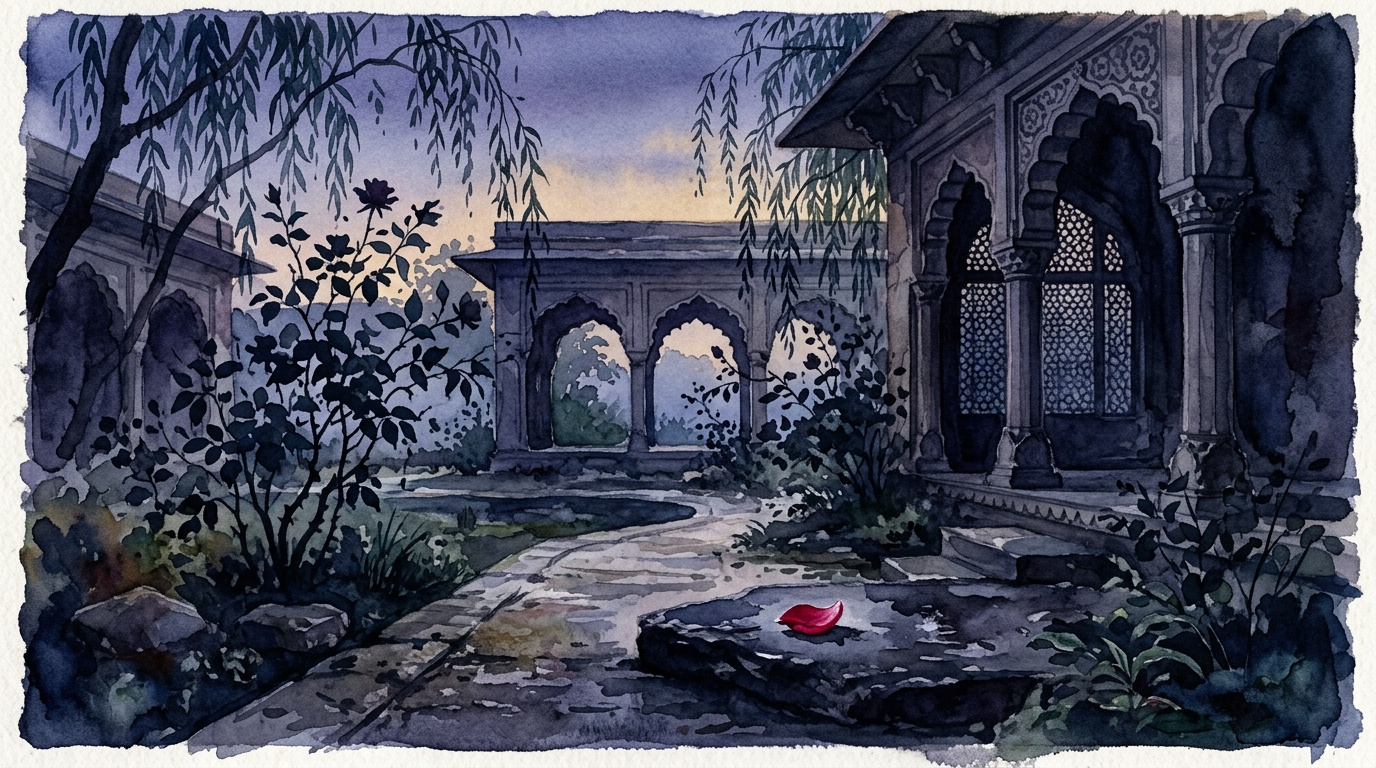
The ghazal opens with one of the most famous couplets in the entire Hindustani literary canon. Mir invokes the beloved landscape of Persian and Urdu lyricism: the bagh (garden), inhabited by the helpless nightingale and the aloof, unbending gul (rose).
The emotional punch lies in the contrast between the multitude and the singular. 'Patta patta' (every leaf) and 'boota boota' (every bush) rustle in whispered sympathy. Nature itself is awake to the lover's grief. Yet the one flower for whom the entire garden was cultivated remains detached. Mir plays on a razor-sharp irony: is the rose genuinely unaware, or is it merely pretending not to know? By claiming that the whole garden knows, Mir turns the beloved's apparent innocence into an act of exquisite, quiet cruelty.
The Envy of the Celestial Spheres
لگنے نہ دے بس ہو تو اس کے گوہر گوش کو بالے تک
اس کو فلک چشم مہ و خور کی پتلی کا تارا جانے ہے
लगने न दे बस हो तो उस के गौहर-ए-गोश को बाले तक
उस को फ़लक चश्म-ए-मह-ओ-ख़ुर की पुतली का तारा जाने है
Lagne na de bas ho to us ke gauhar-e-gosha ko baale tak,
Us ko falak chashm-e-meh-o-khur ki putli ka tara jaane hai
If the sky had its way, it would not let an earring touch the pearl of that ear;
For heaven considers it the bright star in the pupil of the sun and moon.
Mir shifts focus from the garden to the cosmic stage. He watches an earring brush against the beloved's earlobe and imagines the night sky burning with sheer jealousy. In Urdu poetry, falak (the heavens or destiny) is often an envious, meddling force.
The poet constructs a magnificent conceit: the delicate skin or the pearl adorning the beloved's ear is so luminous that the heavens regard it as the ultimate pupil within the cosmic eyes of the sun and moon. Why should a common metallic jewel dare touch something so sacred? Beneath the conventional flattery lies the lover's torment: even an inanimate ornament gets closer to the beloved than he ever will.
Praying to a Self-Adoring Idol
آگے اس متکبر کے ہم خدا خدا کیا کرتے ہیں
کب موجود خدا کو وہ مغرور خود آرا جانے ہے
आगे उस मुतकब्बिर के हम ख़ुदा ख़ुदा किया करते हैं
कब मौजूद ख़ुदा को वो मग़रूर-ए-ख़ुद-आरा जाने है
Aage us mutakabbir ke hum Khuda Khuda kiya karte hain,
Kab maujood Khuda ko woh maghroor-e-khud-ara jaane hai?
Why do we keep crying out to God before that arrogant beauty?
When has that self-adoring narcissist ever acknowledged the living God?
In this couplet, Mir pivots into sudden, startling irreverence. The lover kneels before the beloved, desperate and pleading, invoking God's mercy with every breath ('Khuda Khuda kya karte hain'). But he stops himself to deliver a bitter realization.
The beloved is 'khud-aara'—self-adoring, engrossed entirely in their own mirror reflection. To someone who considers their own beauty supreme, what meaning does an invisible Creator possess? On a worldly plane, it dissects the futility of begging for empathy from a narcissist. On a mystical plane, it touches the Sufi paradox of the idol (sanam): the lover's devotion has elevated the human beloved into a false deity who displaces heaven itself.
The Fool's Balance Sheet
عاشق سا تو سادہ کوئی اور نہ ہوگا دنیا میں
جی کے زیاں کو عشق میں اس کے اپنا وارا جانے ہے
आशिक़ सा तो सादा कोई और न होगा दुनिया में
जी के ज़ियाँ को इश्क़ में उस के अपना वारा जाने है
Āshiq sā to sāda koī aur na hogā duniyā mein
Jī ke ziyāñ ko ishq mein us ke apnā vārā jāne hai
There could be no one simpler in the world than a lover;
He counts the ruin of his very life in her love as his greatest profit.
Here Mir lays bare the strange psychology of ishq (passionate love). To the pragmatic world, life is an exercise in preservation: you protect your wealth, your status, and above all, your breath. But the lover operates on an inverted ledger.
The word 'saada' denotes innocence, gullibility, and artlessness. Mir uses it with tender pity. The lover watches his life crumble—his peace shattered, his youth spent, his vitality drained—and yet rejoices. He calls 'ziyaan' (loss or ruin) his 'waara' (profit or lucky gain). It is the quintessential paradox of devotion: love demands complete surrender, where finding yourself bankrupt is the only victory that matters.
The Cruel Etiquette of the City of Beauty
چارہ گری بیماری دل کی رسم شہر حسن نہیں
ورنہ دلبر ناداں بھی اس درد کا چارہ جانے ہے
चारागरी बीमारी-ए-दिल की रस्म-ए-शहर-ए-हुस्न नहीं
वर्ना दिलबर-ए-नादाँ भी इस दर्द का चारा जाने है
Chārāgarī bīmārī-e-dil kī rasm-e-shahr-e-husn nahīn
Varnā dilbār-e-nādāñ bhī is dard kā chārā jāne hai
Healing the sickness of the heart is simply not the custom in the city of beauty;
Otherwise, even that naive darling knows the remedy for this ache.
Why doesn't the beloved soothe the lover's agony with a single kind word? Mir refuses to blame childish ignorance. He invents an entire mythical realm: 'shahr-e husn', the city of beauty.
Every city has its own customs, laws, and codes of conduct. In the city of beauty, mercy is strictly forbidden. The beloved may appear youthful and inexperienced ('dilbar-e naadaan'), but do not be deceived. They know the cure perfectly well; they simply refuse to administer it because cruelty is the established etiquette of their world. With chilling calm, Mir strips away the excuse of innocence.
The Illusion of the Young Hunter
کیا ہی شکار فریبی پر مغرور ہے وہ صیاد بچہ
طائر اڑتے ہوا میں سارے اپنے اساریٰ جانے ہے
क्या ही शिकार-फ़रेबी पर मग़रूर है वो सय्याद बचा
ताइर उड़ते हवा में सारे अपने असारा जाने है
Kyā hī śikār-farebī par maghrūr hai vo sayyād bachā
Tāir uṛte havā mein sāre apne asārā jāne hai
How excessively proud of his trapping trickery is that young hunter;
He imagines that every bird soaring in the air is already his captive.
Mir turns to the classical metaphor of the sayyaad (the hunter or trapper). The beloved is a fledgling hunter, puffed up with vanity, convinced that a few charms and coquettish glances have trapped every creature in sight.
There is a biting psychological observation here. Those who possess beauty or power frequently confuse freedom with their own dominion. They look at birds flying high in the wide blue sky and imagine them already snared in their invisible net. It is a quiet mockery of youth's boundless arrogance, delivered with the world-weary smile of an older soul.
Masters of Innuendo, Illiterate in Grace
مہر و وفا و لطف و عنایت ایک سے واقف ان میں نہیں
اور تو سب کچھ طنز و کنایہ رمز و اشارہ جانے ہے
मेहर ओ वफ़ा ओ लुत्फ़-ओ-इनायत एक से वाक़िफ़ इन में नहीं
और तो सब कुछ तंज़ ओ किनाया रम्ज़ ओ इशारा जाने है
Mehar o wafa o lutf-o-inaayat ek se waqif in mein nahi
Aur to sab kuch tanz o kinaaya ramz o ishaara jaane hai
Not acquainted with a single virtue among affection, loyalty, grace, or kindness;
Yet knowing everything there is of sarcasm, innuendo, secrets, and subtle gestures.
This is one of the sharpest satirical couplets in the ghazal. Mir lists four noble qualities of human relationship: mehr (affection), wafa (fidelity), lutf (grace), and inaayat (kindness). In all four, the beloved scores absolute zero.
Yet this emotional illiteracy is not accompanied by intellectual stupidity. When it comes to tanz (sarcasm), kinaaya (mocking innuendo), ramz (cryptic secrets), and ishaara (ambiguous gestures), the beloved is a certified master. The sher strikes home because we all recognize this personality: someone completely unwilling to offer direct emotional warmth, but astonishingly adept at the barbed weapons of passive aggression.
The Magnet for Catastrophe
کیا کیا فتنے سر پر اس کے لاتا ہے معشوق اپنا
جس بے دل بے تاب و تواں کو عشق کا مارا جانے ہے
क्या क्या फ़ित्ने सर पर उस के लाता है माशूक़ अपना
जिस बे-दिल बे-ताब-ओ-तवाँ को इश्क़ का मारा जाने है
Kya kya fitne sar par us ke laata hai maashooq apna jis be-dil be-taab-o-tawaan ko ishq ka maara jaana hai
What endless catastrophes the beloved heaps upon his head,
Knowing that this broken, powerless soul is entirely struck down by love!
Cruelty, Mir observes, is rarely democratic; it searches out the most vulnerable prey. The moment the beloved realizes someone is 'be-dil' (heartbroken) and 'be-taab-o-tawaan' (destitute of strength), the trials multiply.
Instead of evoking sympathy, the lover's visible surrender acts as an invitation for further torment ('fitne', chaotic disasters). In Mir's universe, love does not shelter you from the storm. Love makes you the lightning rod. The sher captures the brutal realism of human power dynamics: showing weakness to an indifferent power only accelerates your destruction.
Peeking Through the Garden Crevices
رخنوں سے دیوار چمن کے منہ کو لے ہے چھپا یعنی
ان سوراخوں کے ٹک رہنے کو سو کا نظارہ جانے ہے
रख़नों से दीवार-ए-चमन के मुँह को ले है छुपा या'नी
इन सूराख़ों के टुक रहने को सौ का नज़ारा जाने है
Rakhnon se deewar-e-chaman ke munh ko le hai chhupa Ya'ni,
In surakhon ke tuk rehne ko sau ka nazara jaane hai
Hiding the face behind the crevices of the garden wall, as if
Lingering by those narrow slits could equal gazing upon a hundred spectacles.
This sher evokes an intensely visual, almost cinematic scene. The garden wall is fractured with fissures and small chinks ('rakhnon'). Someone—perhaps the guarded beloved, perhaps the banished lover—is peeking through the stone.
There is a poignant double meaning. On one hand, the beloved plays hide-and-seek, rationing glimpses of beauty through narrow gaps, believing that making the lover strain for a fraction of a view is worth a hundred open vistas. On the other, it reflects the lover's pathetic starvation: reduced to squinting through cracks in the wall, he convinces himself that this meager glimpse is a grand feast of vision.
Drinking the Luster of the Executioner's Blade
تشنۂ خوں ہے اپنا کتنا میرؔ بھی ناداں تلخی کش
دم دار آب تیغ کو اس کے آب گوارا جانے ہے
तिश्ना-ए-ख़ूँ है अपना कितना 'मीर' भी नादाँ तल्ख़ी-कश
दम-दार आब-ए-तेग़ को उस के आब-ए-गवारा जाने है
Tishna-e-khoon hai apna kitna 'Mir' bhi naadan talkhi-kash
Dam-daar aab-e-tegh ko us ke aab-e-gawara jaane hai
How bloodthirsty against himself is poor, suffering Mir;
He mistakes the lethal gleam of her sword for cool, refreshing water!
The ghazal closes with Mir addressing himself in the third person, crafting an unforgettable concluding paradox. He calls himself 'talakhi-kash' (one who drinks bitterness) and 'tashna-e khoon' (thirsty for blood)—not another's blood, but his own.
The genius of the sher lies in a brilliant untranslatable pun on the Persian word 'aab'. In classical usage, 'aab' means water, but 'aab-e tegh' specifically denotes the tempered gleam and watery wavy pattern on a finely forged steel blade. The dying lover, scorched by the heat of longing, sees the executioner's sword flashing above him. Instead of fleeing, his delirium reads the lethal glint as 'aab-e gawaara'—sweet, life-giving water to quench his soul. Mir welcomes the fatal blow as if it were a cup of nectar.
Words to Know
Boota (بوٹا)
A small bush, shrub, or flowering plant; used alongside 'patta' to represent the collective minor life of the garden.
Mutakabbir (متکبر)
Arrogant, proud, or haughty; in classical poetry, the beloved who disdains all suitors.
Khud-aara (خود آرا)
Self-adoring or narcissistic; one who decorates themselves for their own delight rather than for others.
Ziyaan (زیاں)
Damage, loss, or ruin; contrasted in commerce against profit.
Waara (وارا)
Profit, gain, or favorable return; an idiom for a worthwhile bargain.
Chaaragari (چارہ گری)
The act of healing, curing, or providing a remedy for an affliction.
Sayyaad (صیاد)
The hunter or fowler; symbolic of the beloved who traps lovers' hearts like songbirds.
Kinaaya (کنایہ)
Innuendo, allusion, or veiled speech; saying one thing to imply another hurtful truth.
Aab-e Tegh (آب تیغ)
The watery sheen and sharpness of a steel sword blade; a literary pun playing on water and death.
Gawaara (گوارا)
Pleasant, digestible, or agreeable; 'aab-e gawaara' refers to sweet drinking water.
The Life Behind the Lines: Mir's Wounded Delhi
Mir Taqi Mir lived through the agonizing dismemberment of Mughal Delhi. Born in Agra around 1723, he arrived in the imperial capital only to witness it sacked repeatedly by Nadir Shah, Ahmad Shah Abdali, and predatory Maratha and Rohilla forces. Streets that once echoed with music and philosophy were strewn with rubble and corpses.
Yet Mir never wrote purely political manifestos. Instead, the historical ruin of his beloved city filtered directly into his personal landscape of grief. When Mir speaks of a ruined heart, an indifferent sky, or a garden where every bush whispers of catastrophe, he is speaking with the voice of an entire displaced civilization. His personal melancholy (known in Urdu tradition as 'soz' or burning sorrow) was forged in the fires of an empire collapsing around him. That is why his tone in 'Patta patta boota boota' never turns hysterical. It possesses the dignity of a man who has looked directly at absolute loss and chosen to weave it into silk.
Echoes Across Time
The paradox at the center of this ghazal—where suffering becomes identity and destruction is welcomed as salvation—finds striking resonances across world literature.
Consider Shakespeare's 'Twelfth Night', where Viola muses on secret passion: 'She never told her love, / But let concealment, like a worm i' the bud, / Feed on her damask cheek.' Viola’s concealment leads to a slow wasting away that everyone notices while the object of affection remains oblivious. Mir takes this very concealment and turns it inside out: his lover does not even have the luxury of private grief; the entire neighborhood watches him burn.
Similarly, in the closing sher, Mir's mistaking the executioner's sword for cool water mirrors the profound Sufi paradox articulated centuries earlier by Rumi: 'The wound is the place where the Light enters you.' For Mir, death at the hands of love is not an defeat; it is the ultimate baptism of truth.
Why Mir's Garden Still Matters
We live in an age that demands relentless cheerfulness, productivity, and closure. When a relationship falters today, we are urged to cut our losses, optimize our emotional investments, and move briskly along. Vulnerability is treated like an embarrassing software glitch.
Mir offers an intoxicating counter-wisdom. He reminds us that to love foolishly, to gamble everything on someone who may never reciprocate, and to mourn openly is not a sign of failure—it is proof of being entirely, gloriously human. He grants nobility to heartbreak. When you sit with Mir, your grief is no longer an isolated defect; it becomes a piece of classical architecture.
Have you ever loved someone so deeply that even the ruin of your peace felt like the only gift worth keeping?
Long after the garden withers, the song of the wounded bird remains the only thing that outlasts the stone.
Explore in Sukhan AI
This article is linked to poems, poets, and couplets from the Sukhan AI archive.
What is the core meaning of 'Patta patta boota boota haal hamara jaane hai'?
It means every leaf and every bush in the garden knows our sorrow, yet the very rose we love pretends not to notice. It captures the painful irony of unrequited love, where your secret heartbreak is obvious to the whole world except the beloved.
Who wrote 'Patta patta boota boota'?
The ghazal was composed by Mir Taqi Mir, the legendary 18th-century Urdu poet known as 'Khuda-e Sukhan' (God of Poetry). His signature pen-name (takhallus) appears directly in the final couplet (maqta).
What is the poetic device used in the final couplet regarding 'Aab-e tegh'?
Mir uses 'Iham' (double entendre) with the Persian word 'aab'. It means both 'water' and the 'luster/sheen of a blade'. Mir brilliantly portrays the dying lover mistaking the fatal flash of the beloved's sword for sweet, thirst-quenching drinking water.
Why is Mir Taqi Mir considered the master of melancholic Urdu poetry?
Mir lived through the catastrophic sackings of 18th-century Delhi. His personal heartbreak and the destruction of his city merged into a distinct aesthetic of refined, restrained grief ('soz-o-gudaz'), making his simple, conversational diction profoundly moving across generations.