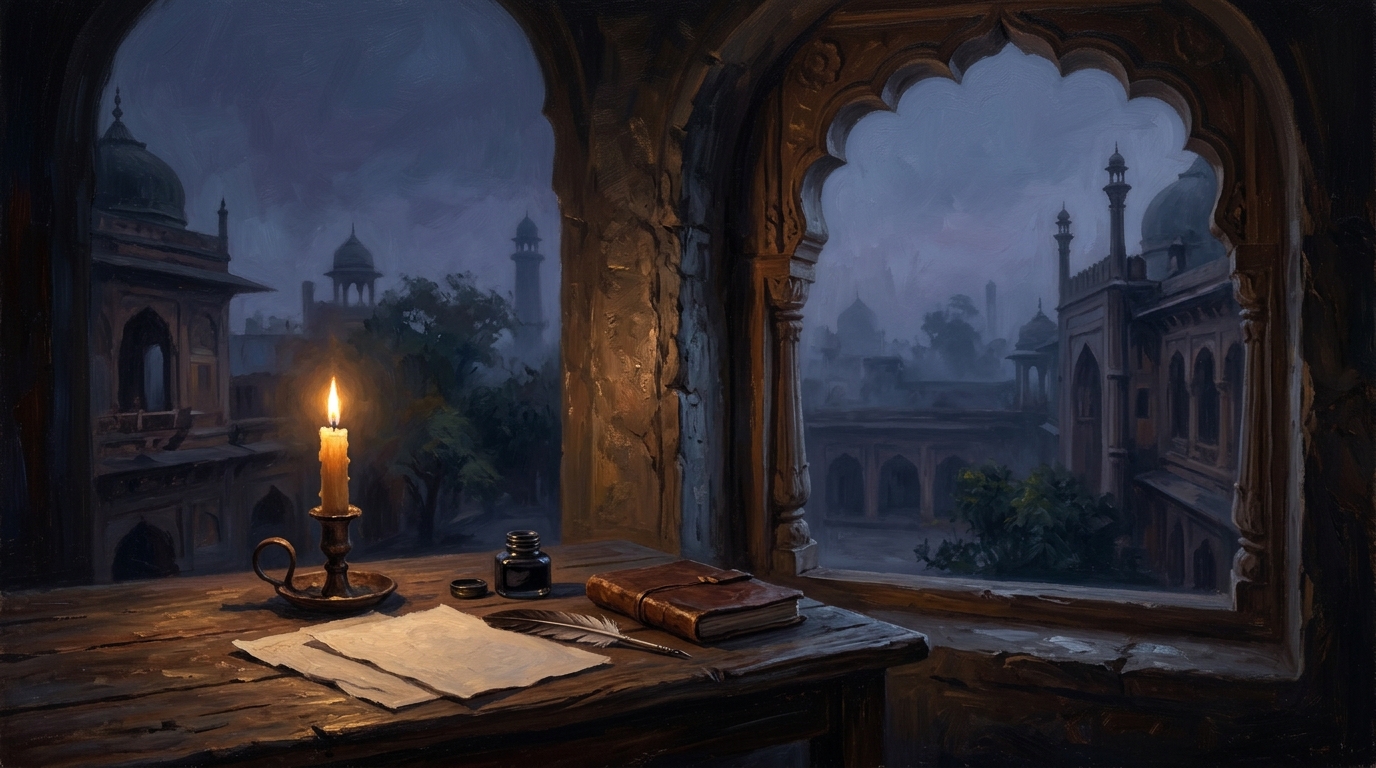
Have you ever sat quietly late at night and felt overwhelmed simply by the fact that you exist? Most of us are taught to celebrate life as an unvarnished blessing. Yet there are solitary moments when consciousness itself feels heavy, when the sheer effort of carrying an identity, a name, and a history becomes exhausting. We wonder what we were before we arrived here, and why we were pulled into the turbulence of the world.
Over a century and a half ago in the narrow alleys of Old Delhi, Mirza Ghalib asked this exact question with unrivaled audacity. In his famous opening line, 'Na tha kuchh to khuda tha kuchh na hota to khuda hota', he turned the entire drama of human creation on its head, suggesting that our greatest tragedy was not that we might die, but that we were ever born at all.
A Masterpiece of Wit and Despair
Composed in nineteenth-century Delhi during the twilight of the Mughal era, this ghazal captures Ghalib at his most contemplative and subversive. The mood shifts effortlessly between cosmic grief, dark humor, and self-mockery.
Structurally, the poem follows the strict geometry of classical Urdu poetry. Its radif (the recurring refrain) is the unassuming verb 'hota' (would be), which anchors the entire piece in the realm of hypothetical regret. Preceding it is the qafia (the rhyming sound), seen in words like 'khuda' (God), 'kya' (what), and 'dhara' (placed). The opening couplet, or matla, establishes the cosmic stakes, while the closing couplet, the maqta, features Ghalib's poetic pen-name (takhallus) spoken from beyond the grave. In the ghazal tradition, each two-line sher functions as an autonomous universe, yet here they are unified by a single haunting thread: the relentless ache of what might have been.
Decoding the Verses: From Void to Longing
To understand Ghalib is to look past his deceptive simplicity and search for the paradox hidden beneath every word.
The Catastrophe of Becoming
نہ تھا کچھ تو خدا تھا کچھ نہ ہوتا تو خدا ہوتا
ڈبویا مجھ کو ہونے نے نہ ہوتا میں تو کیا ہوتا
न था कुछ तो ख़ुदा था कुछ न होता तो ख़ुदा होता
डुबोया मुझ को होने ने न होता मैं तो क्या होता
Na tha kuchh to Khuda tha kuchh na hota to Khuda hota
Duboya mujh ko hone ne na hota main to kya hota
When there was nothing, God was; had there been nothing, God would have remained. My existence has drowned me; had I not existed, what would have been?
Ghalib opens with a breathtaking philosophical premise. Before creation, there was only the absolute unity of the Divine. Had the universe remained empty, that divine wholeness would still be intact. Instead, the individual entered the world, fragmented and isolated. The poet declares, 'Duboya mujh ko hone ne' (My being has drowned me). The metaphor of drowning is deliberate: we normally fear drowning in water, but Ghalib drowns in his own ego and finite existence.
The second line contains a dazzling double meaning. On one hand, 'had I not existed, what would have been?' is a shrug of despair, implying that his non-existence would have caused no harm to the cosmos. On the other hand, reading it through Sufi philosophy, it suggests: had I not become a separate 'I', I would have remained dissolved in the Divine. By coming into being, humanity fell from infinite divinity into finite suffering.
The Posture of Numbness
ہوا جب غم سے یوں بے حس تو غم کیا سر کے کٹنے کا
نہ ہوتا گر جدا تن سے تو زانو پر دھرا ہوتا
हुआ जब ग़म से यूँ बे-हिस तो ग़म क्या सर के कटने का
न होता गर जुदा तन से तो ज़ानू पर धरा होता
hua jab gham se yoon be-his to gham kya sar ke katne ka
Na hota gar juda tan se to zaanoo par dhara hota
When I have become so numb to sorrow, what grief is there in losing my head? Had it not parted from my body, it would still be resting upon my knees.
Here Ghalib turns from metaphysical philosophy to visceral, bodily imagery. He addresses the ultimate punishment—decapitation—with startling indifference. When a soul has experienced unrelenting suffering, pain ceases to register. The mind becomes 'be-his' (numb, desensitized).
The genius of the sher lies in the posture described in the second line. In classical Eastern painting and poetry, resting one's head on one's knees (sar-ba-zaanu) is the quintessential posture of brokenhearted grief. Ghalib remarks with bitter irony that whether his head is chopped off by an executioner or remains attached to his neck, its destination is the same: bowed in sorrow. Loss of life is no terror to someone whose life is already defined by grief.
A Voice Echoing Beyond Death
ہوئی مدت کہ غالبؔ مر گیا پر یاد آتا ہے
وہ ہر اک بات پر کہنا کہ یوں ہوتا تو کیا ہوتا
हुई मुद्दत कि 'ग़ालिब' मर गया पर याद आता है
वो हर इक बात पर कहना कि यूँ होता तो क्या होता
Hui muddat ki '
Ghalib' mar gaya par yaad aata haiWoh har ik baat par kehna ki yoon hota to kya hota
It has been an eternity since Ghalib died, yet I still remember his constant habit of saying: if only it were like this, what then?
The ghazal concludes with one of the most famous maqtas in Urdu literature. Ghalib writes about himself in the third person, looking back from a distant future after his own death. He does not remember himself as a great scholar, lover, or courtier, but simply as a man who could never stop questioning reality.
This sher captures the universal human obsession with counterfactuals—the endless game of 'what if'. By mocking his own tendency to dissect every moment and wish for alternative outcomes, Ghalib transforms personal grief into affectionate self-satire. Even in the grave, the ghost of Ghalib continues to interrogate the universe.
Essential Vocabulary
ख़ुदा (Khuda)
God or the supreme Divine reality; in Sufi thought, the ultimate unmanifest Void.
होने ने (Hone ne)
The act of existing; individual ego and selfhood.
बे-हिस (Be-his)
Numb, insensate, drained of feeling through excessive pain.
ज़ानू (Zaanu)
The knee; symbolically associated with deep contemplation and brooding grief.
मुद्दत (Muddat)
A long span of time, an age, or an eternity.
The Life Behind the Lines
Mirza Asadullah Khan Ghalib lived through a world collapsing in real time. Born in Agra in 1797 and residing in Delhi until his death in 1869, he witnessed the fall of the Mughal dynasty and the brutal aftermath of the 1857 uprising. He buried all seven of his infant children, struggled with perpetual debt, and saw his beloved city ravaged by war and exile.
Yet Ghalib refused to write purely conventional laments. He brought a sharp, intellectual skepticism to his work. Where orthodox theologians demanded unquestioning gratitude, Ghalib bantered with the Almighty, challenging the purpose of creation and turning his personal tragedies into cosmic inquiries. His verses do not wallow in self-pity; they wear their scars with aristocratic wit and profound philosophical courage.
Echoes Across Traditions
Ghalib's lament over existence finds a striking counterpart in the 15th-century mystic Kabir, who also questioned the separation of the drop from the ocean. While Kabir sought ecstasy in merging back with the divine source (fana), Ghalib views the separation through the lens of tragic irony: why tear the soul away from God only to drown it in mortality?
In Western literature, the final couplet directly mirrors Hamlet's restless intellect. Like Shakespeare's Danish prince, who is paralyzed by the habit of thinking too precisely on the event, Ghalib's defining trait is his relentless analysis of possibilities. Both writers recognize that the human mind's greatest gift—its ability to imagine alternative realities—is also its sharpest curse.
Why Ghalib's Question Still Matters
In a modern culture driven by the constant urge to optimize, achieve, and define the self, Ghalib offers a startling pause. He validates the quiet exhaustion that comes with being human in an uncertain world. When our plans collapse and our minds race through endless scenarios of how things might have gone differently, we are doing what Ghalib did every single day.
How much of your present peace is lost to the ghost of what might have been?
Perhaps the wisdom of this ghazal lies in letting go of the alternative lives we never lived, and finding peace in the imperfect one we inhabit.
Explore in Sukhan AI
This article is linked to poems, poets, and couplets from the Sukhan AI archive.
What is the central meaning of 'Na tha kuchh to khuda tha'?
The line suggests that before creation, pure divine unity existed. By granting humans individual existence, God pulled us away from that divine wholeness into a world of suffering. Ghalib implies that our mortal identity is what separated us from our original divine nature.
What poetic devices are used in this ghazal?
Ghalib utilizes the radif 'hota' to maintain a hypothetical, questioning tone throughout the poem. He also employs tazad (antithesis) between being and non-being, alongside deep wordplay in the phrase 'kya hota', which can mean both insignificance and divine realization.
Why does Ghalib speak of himself as already dead in the final sher?
This technique, common in advanced ghazal writing, allows the poet to observe his life objectively from a post-mortem vantage point. It infuses the verse with self-irony, cementing Ghalib's reputation as an eternal thinker haunted by hypothetical questions.