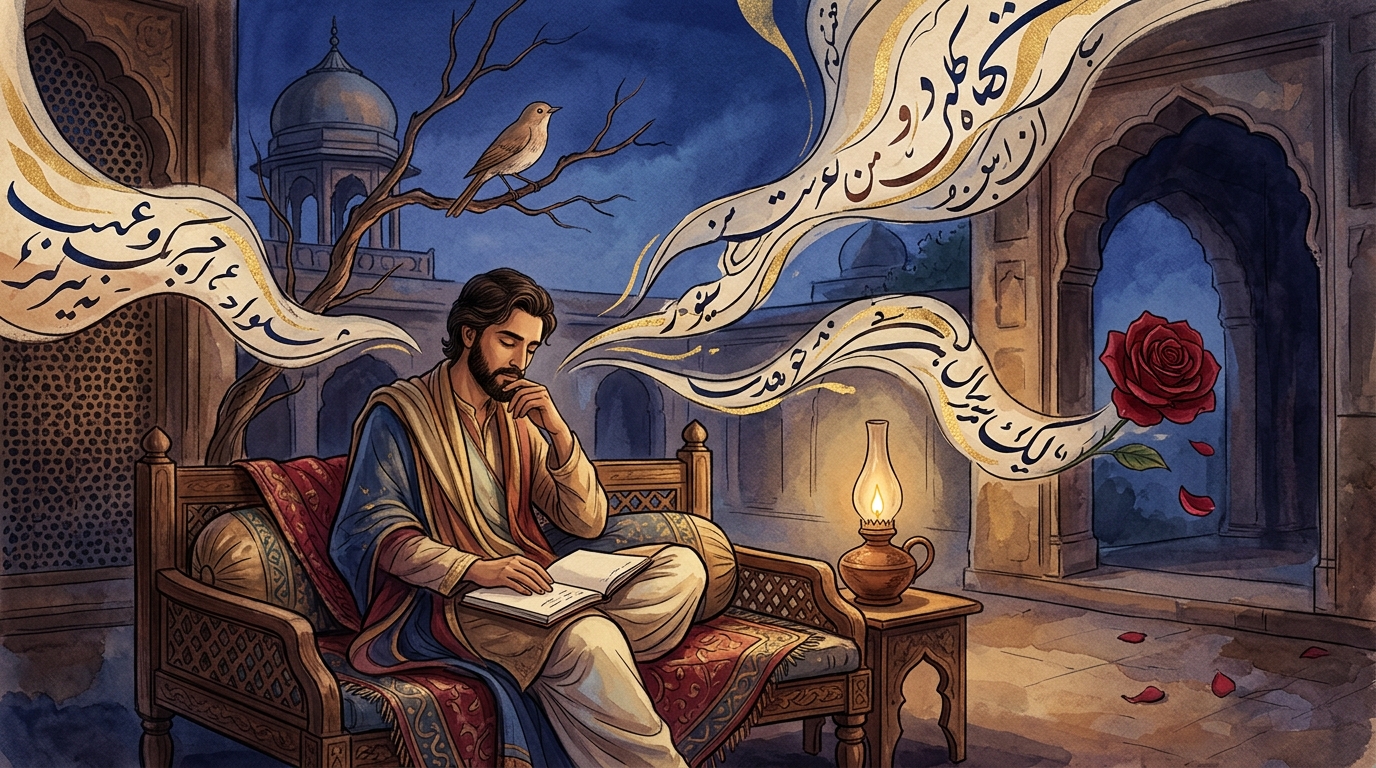
An Introduction to the World of Ghazals
Have you ever been captivated by a piece of music or poetry that felt deeply profound, even if you didn't fully grasp every word? That's often the magic of an Urdu ghazal. Ghazals are not just poems; they are a rich tradition, a profound expression of human emotion and philosophy, set within a highly structured poetic form. For beginners, they might seem daunting, but with a few keys, you can unlock a world of beauty and wisdom that has enchanted audiences for centuries.
Why Ghazals Matter: Beyond Just Words
Ghazals are more than ancient verses; they are living art. They teach us about love, loss, longing, spirituality, and the complexities of life itself. Understanding ghazals connects you to a vibrant cultural heritage that spans across South Asia and beyond. Legendary poets like Mirza Ghalib and Mir Taqi Mir have left behind a legacy that continues to resonate, offering solace, inspiration, and profound insights into the human condition. Learning to appreciate them enriches your linguistic skills and emotional intelligence, opening doors to a deeper understanding of art and culture.
The Core Structure: What Makes a Ghazal a Ghazal?
At its heart, a ghazal is a collection of couplets, known as 'ash'aar' (singular: 'sher'). Each sher is a complete thought in itself, yet it connects to the overall mood and theme of the ghazal. Ghazals follow a strict rhyming scheme and meter. The first couplet, called 'matla', sets the rhyme and refrain (radif and qafiya), which are then carried through the second line of every subsequent couplet. The final couplet, 'maqta', often includes the poet's pen name (takhallus). This unique structure allows for diverse ideas to be explored within a unified poetic flow.
Understanding the Independent Sher: A World in Two Lines
One of the most distinctive features of a ghazal is that each couplet (sher) is often a self-contained unit of meaning. While the ghazal as a whole might have an overarching theme, individual shers can present distinct ideas, metaphors, or emotions. For instance, consider this profound sher by Mirza Ghalib, where he offers solace and perspective:
"बेगानगी-ए-ख़ल्क़ से बे-दिल न हो 'ग़ालिब'
कोई नहीं तेरा तो मिरी जान ख़ुदा है"
*Begānagī-e-khalq se be-dil na ho 'Ghalib'*
*Koī nahīñ terā to mirī jān ḳhudā hai*
(Ghalib, don't lose heart to the world's estrangement, if no one is yours, my dear, then God is.) This couplet stands alone as a complete thought, offering comfort and a spiritual outlook regardless of the surrounding verses in the ghazal.
Decoding Emotional Meaning: Themes of Love and Longing
Ghazals are renowned for their exploration of intense emotions, particularly those related to love ('ishq'), separation ('hijr'), and longing ('hasrat'). This love is often multifaceted, encompassing romantic, platonic, and divine dimensions. The pain of separation and the yearning for union are central motifs, often expressed through rich metaphors. Mir Taqi Mir, known as the 'God of Poetry,' masterfully captures this emotional anguish:
"मूए ही जाते हैं हम दर्द-ए-इश्क़ से यारो
कसो के पास इस आज़ार की दवा भी है"
*Mūe hī jāte hain ham dard-e-ishq se yāro*
*Kaso ke pās is āzār kī davā bhī hai*
(We are departing from the pain of love, O friends, do you have any medicine for this distress?) This sher beautifully conveys the overwhelming nature of love's pain, a sentiment instantly relatable across cultures and generations.
Philosophical Depths: Beyond Earthly Concerns
Many ghazals transcend earthly love to delve into deep philosophical and spiritual questions. Poets often use the language of worldly love to discuss divine love, the nature of existence, fate, and human purpose. Allama Iqbal, a poet-philosopher, encapsulates this in his verse:
"इश्क़ की इक जस्त ने तय कर दिया क़िस्सा तमाम
इस ज़मीन ओ आसमाँ को बे-कराँ समझा था मैं"
*Ishq ki ik jast ne tay kar diya qissa tamaam*
*Is zameen o aasmaan ko be-karaan samjha tha main*
(With a mere thread of love, the whole story was decided, I had taken the entire earth and sky for something endless.) This illustrates how 'ishq' (love) can be a transformative force, capable of resolving grand existential dilemmas that seem boundless.
The Power of Hidden Meanings: Symbolism and Allusion
Urdu ghazals are rich in symbolism. A 'saaqi' (cup-bearer) might represent a beloved or a divine guide, while 'mai' (wine) can signify spiritual enlightenment or intoxication with divine love. Understanding these layers requires familiarity with classical Persian and Urdu literary traditions. For instance, the 'fire of desire' or 'hidden passion' can often be a metaphor for the profound, consuming nature of spiritual longing, as seen in Ghalib's lines:
"दिल मिरा सोज़-ए-निहाँ से बे-मुहाबा जल गया"
*Dil mirā soz-e-nihāñ se be-muhāba jal gayā*
(My heart, without hesitation, burned away from hidden passion.) Such allusions add immense depth, inviting readers to reflect beyond the literal.
Experiencing Ghazals: The Importance of Listening
While reading ghazals is rewarding, listening to them recited or sung (often referred to as 'ghazal singing' or 'ghazal gayaki') is a truly immersive experience. The musicality, rhythm, and intonation bring the poetry to life in a way that text alone cannot. Many classical ghazals have been set to music by renowned artists, allowing the emotional nuances to be fully appreciated. Seek out recordings by maestros like Jagjit Singh, Mehdi Hassan, or Ghulam Ali to truly feel the impact of these timeless verses. Their renditions often provide a deeper insight into the intended mood and flow of the ghazal.